Showing posts with label Amritsar. Show all posts

Thursday, 15 March 2012

The golden temple, Amritsar


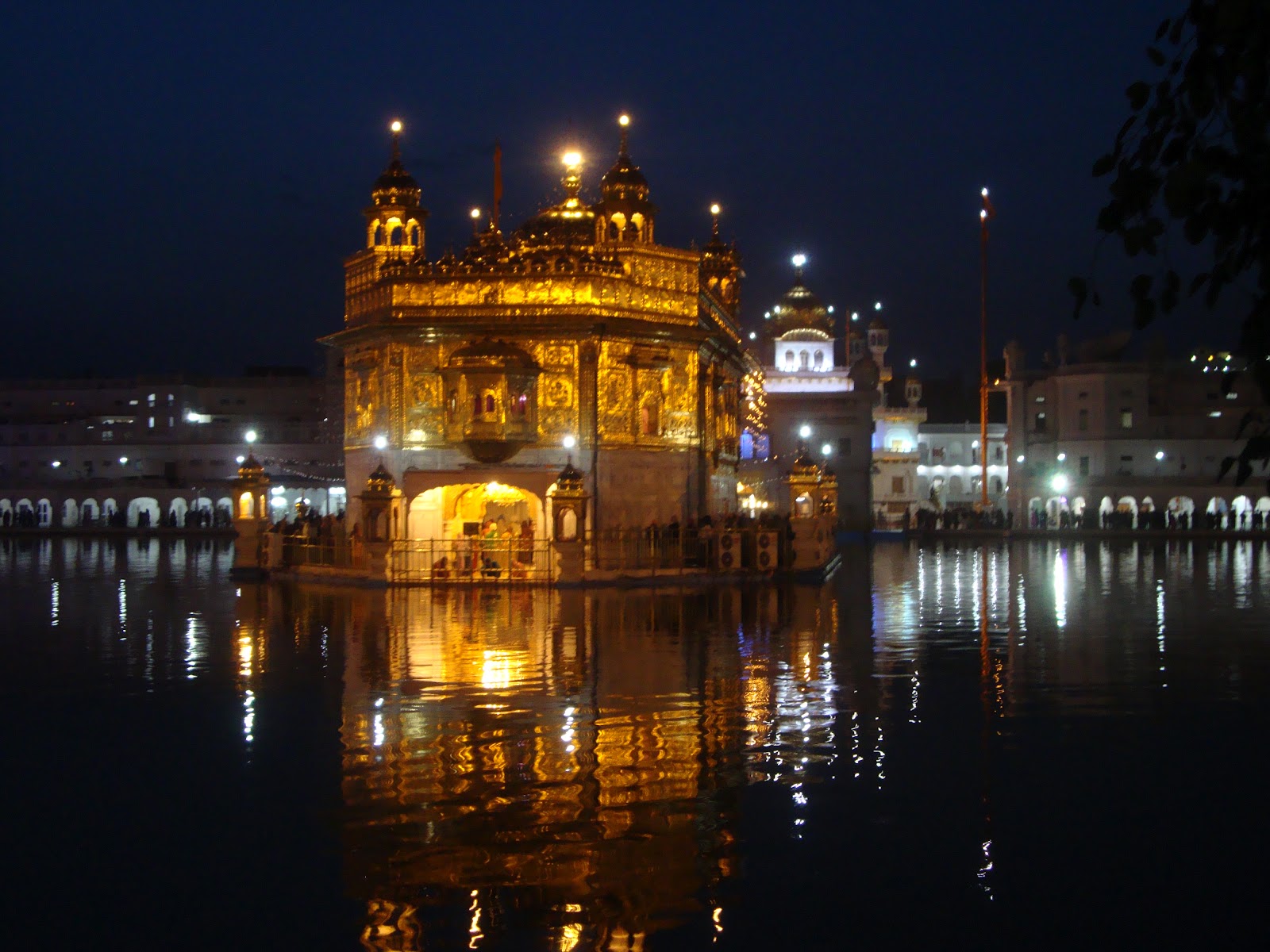
People stand for the sunset prayers. In the evening the golden temple seems to be lit from within, glowing with a golden light that is reflected in the shimmering lake. The singers are singing the Sikh scriptures, which appear, translated on a screen in a corner of the courtyard. The scriptures are beautifully poetic and many devotees know them by heart.

I met a young French man who is travelling the world with only enough money to pay for visas. He hitchhikes and accepts food that is offered to him. He sleeps in a tent, or is invited into people’s houses. In Turkey and Iran people invited him to stay wherever he went. He left France with 250 euros and he still has 100 euros. In India he can sleep and eat in Sikh temples and work in the kitchen as payment. He plans to boat hitch hike his way through Malaysia and Indonesia.

The temple inn is a three storey building with balconies, where the pilgrims hang their washing, round a square courtyard. All the rooms are dormitories, with beds lined up in rows, touching. They are covered by one long sheet that time doesn’t look as if it has been changed for a long time. At times like this I am glad of my sleeping bag.

In the evening they lay long felt mats in the courtyard of the inn for all the pilgrims who arrived too late for a place in a dormitory. They are provided with thick quilts to lie on and to cover themselves with. Soon the whole courtyard is a bumpy sea of quilt-covered bodies.

I visited the Sikh museum, which is full of gory paintings of Sikh martyrs, who died horribly, tortured to death by Muslims in the seventeenth and eighteenth centuries. There is no mention of what the Sikhs did to the Muslims. Then there were the British massacres, which were not particularly directed against the Sikhs, but some Sikhs were caught up in them. And then there is a photo of the temple destroyed by Indira Ghandi, after which her Sikh bodyguards killed her. Terrible massacres of Sikhs occurred all over India after that. 

The Sikhs are a war-like people, who carry ceremonial daggers, swords and spears. They fought for the British during the two world wars.

I joined a queue of Sikh devotees and was pushed along towards the inside of the temple, where the singers and their tabla players sit together in a black turbaned group. The intricate gold leaf tracery of leaves and the marble walls with their semi-precious stone inlay of flowers all remind me of Mughal architecture and art. In all the battle scenes in the museum I could never make out who was Sikh and who was Muslim. They all wore turbans and brandished their swords fiercely. The wars between the Sikhs and Mughal Muslims went on for centuries in Punjab and Rajasthan and most for a long time the Mughals had the upper hand, but at one point the Sikhs managed to gain a fair sized piece of territory, where they built palaces and called themselves Maharajas. Today the Sikhs live on the border with Pakistan, presumably ready to protect it, should their age-old enemies the Muslims invade.

Journey to Amritsar

Two buses from McCloudGanj to Amritsar, about two hundred kilometres, took eight hours. The roads are terrible, potholed and tortuous and buses have to contend with truck loads of gravel and tractors carrying huge loads. The buses do their best, blaring their horns to try to push the slow traffic even further into the ditch, so that they can get past, but there are buses coming in the other direction, not to mention cars, rikshaws, trucks overtaking trucks and the odd cow. So it's a slow process.

We arrived in Amritsar too late to go to the Golden temple, so I took a thieving rikshaw to the railway station and tried to book a ticket to Delhi for the following day. Unlike the lovely ticket booking system in Delhi, in Amritsar there are queues, supposedly for senior citizens, disabled and ladies, but the so-called ladies push and push. When I remonstrated with them they started shouting at me. In the end the ticket salesman refused to sell me a ticket because I didn't know the number of the train and told me to speak Hindi.

I dragged by bag up and down several staircases and eventually found a cheapish hotel room, with no window, in a side street in the market and went to sleep. Next day I got up and went back to the station to book that train ticket. The early morning mist was compounded by sweepers stirring up the dust and burning the rubbish, including plastic, adding toxic fumes to the dust-laden atmosphere. After a lot of shouting and pushing I eventually got a ticket to Delhi. The train will arrive at 10.30pm, not a good time to arrive. I queued properly. It was everyone else who pushed and shouted at me. There are times when I feel that the Indians don't want foreignors here in India.

Back at the hotel the young man at the desk told me to take a rikshaw to the Golden Temple and when I told him that I'd rather walk the 2 km than have anything to do with those theiving rikshaw drivers, he said "There's a free bus that goes to the temple. It's yellow and it stops outside the station". So I went to look for the yellow bus, queued up and waited. When it arrived the queue began to move. The bus filled up. More people got in. "Go on" said the Sikh herding people into the bus," "It's full" I said "I'll wait for the next one". More and more people stuffed themselves into the bus. It was absolutely packed. I waited half an hour for the next one and got in with my luggage. People climbed over me, tried to sit on my luggage, pushed and shoved. I sat tight. The bus driver had a magnificent white beard and an indigo turban.

Once inside the Golden Temple complex you enter another world, of marble floors, carved marble pillars, cool collonades, enormous sleeping quarters where the beds are lined up in touching rows, enormous dining halls for thousands of pilgrims, sitting cross-legged in rows on the floor, as turbanned Sikhs come round with buckets of dahl which they slop out into the waiting pilgrims' metal plates, splashing drops onto the floor. The loudspeakers play a chant to tabla accompaniment throughout the whole complex.

The golden temple is surrounded by a huge pool of water and all round the pool shining white towers, domes and porticoes. And people, walking round, clockwise, endlessly. Some Sikh men immerse themselves in the pool. At a certain moment in the incantation, the people standing, sitting or walking all stop, kneel down and bow down and touch the floor with their foreheads. The golden temple shines in the sun.