Showing posts with label Ayuthayia. Show all posts

Sunday, 12 February 2012

Ayuthayia day two


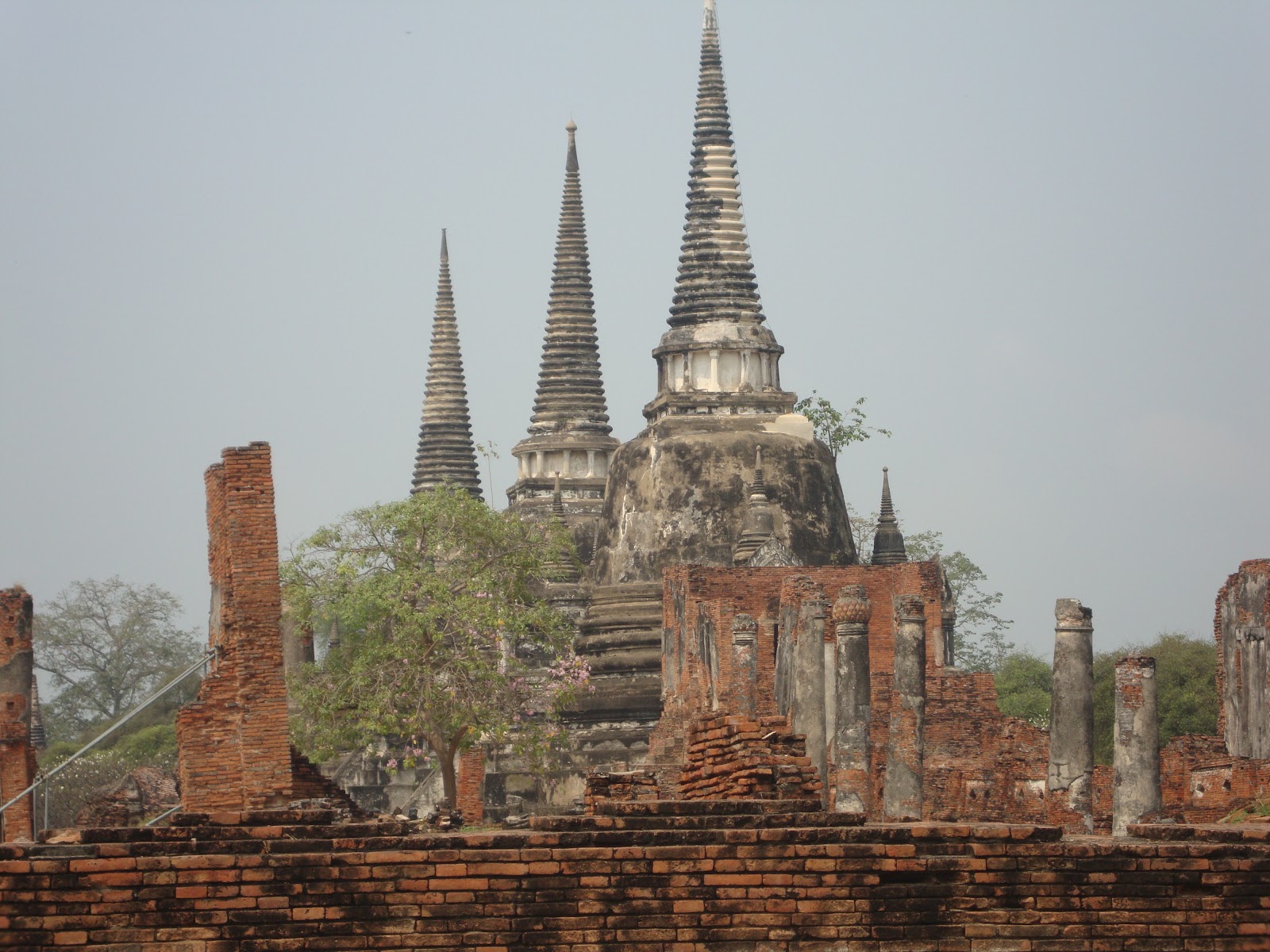
This is Wat Chaiwattanaram, built in 1630 by King  Prasat Thong to celebrate victory over the Khmer  The giant cucumber structure in the centre is called a Pram. It is surrounded by minor Pramgat in eight directions.


We hired bicycles to ride around Ayuthayia. The ancient ruins are surrounded by bicycle-friendly parks, where lakes and canals interweave between trees and little bridges cross the water at frequent intervals. The ruins are built of black stained red brick and were originally covered with plaster.

 Ayuthaya was named after Ayodha, Prince Rama's city in the Indian epic, the Ramayana. It was the capital of Siam (the old name for Thailand) between 1350 and 1767 and at it's peak controlled an area larger than England and France combined and had more than 400 temples.  When the Portuguese arrived in 1511, they were so amazed by its beauty that they called it the Venice of the East. Soon French,  English, Dutch, Chinese and Japanese boats were sailing to Ayuthaya to trade.


The Burmese put an end to all that when they invaded in 1767, sacking and pillaging the city, taking most of its treasures away.

Saturday, 11 February 2012

Ayuthayia


Jacques and I took the slow train to Ayuthayia, capital of the ancient Kingdom of Ayuthayia, a mere two hours from Bangkok. The train took us through the rubbish-filled swamplands of central Thailand, where the houses all hover on stilts above the stagnant water and fertiliser-rich runoff from the rice fields turns the swamp water putrid and green with eutrification. In the midst of all this lie the ruins of the ancient city of Ayuthayia, surrounded by the modern city with its markets, bars, hotels, banks and railway station.

We checked into a cheap hotel and set off on foot in search of the ancient ruins. We jumped on a passing Songthau, which didn't take us in the direction we expected. But, after walking a stretch in the hot sun, we came to signs to a floating market. As we got nearer, coaches, buses and cars passed us on a narrow road. Shops and stalls selling trinkets and souvenirs grew along the roadside. Then we came to a Disney version of a floating market, beyond which we could see the coaches careering through clouds of dust. We followed and soon were in a field of ruins. Lovely red brick towers, the remains of a monastery, with a disintegrating statue of Buddha, who looked like a melting Buddha.


In the distance we saw the ruins of a walled monastery. We walked across the field and round the wall until we came to the entrance. The red brick walls of the monastery had been repaired and a new terracotta floor laid, but there was no roof. Thai people came with lotus flowers and joss sticks to offer to the temple, kneeling for a moment, lighting the incence, adding the lotus flowers to the already full vase, walking round the Buddha altar clockwise, then leaving.

We sat on the floor of the monasstery temple, listening to the birds in the trees all around us.

In the evening Jacques wanted to eat in a local Thai place on the street. He spotted some locals eating chicken feet soup and had to have some too. I decided on tofu soup and was not best pleased to find meat in my soup. That's the trouble with these local roadside places - meat (and chilli) in everything.